
GFC's whole digital ecosystem, CSEP's website redesign and the MobiliseHER website.
01 Research websites
Research website design, planned around everything you publish
Research website design starts from a publishing system, not a brochure. Tailwebs builds websites for think tanks and research institutes with a content model, a publication library, author and topic pages, search across reports and data, and a CMS your team runs. A typical build takes 8–16 weeks and costs ₹6–20 lakh.
Research Website from ₹6 lakh
02 Anatomy of a publication page
What should a think tank website include?
A publication library, topic and programme pages, author pages, events, data and search. Here is one publication page, annotated, because that is where all of them meet.
- 01
Summary first
The key findings in a few lines, at the top, for the reader who will never open the PDF.
- 02
Authors linked to their profiles
Each byline leads to the author's page, which lists all their work.
- 03
Read on the web or download the PDF
The report as a web page with chapters, and the PDF for those who want it.
- 04
A "cite this" line
A citation ready to copy, with the DOI where you use one.
- 05
Related data and dashboards
The datasets and charts behind the findings, one click away.
- 06
Topic and programme tags
Each tag leads to a hub of related work, so one piece leads to the next.
- 07
Language toggle
Translations linked to the original, so a reader can switch without losing the page.
- 08
Accessibility built into the template
Heading order, alt text, keyboard use and contrast are part of the template, so every new page inherits them.
Where the PDFs, tags and review queue behind this page come from: research content systems.
03 The content model
The content model, designed before any pixels
Before any design, we agree the kinds of work you publish, the people behind it and the tags that connect it. A clear model is what lets your editors publish without a developer.
A live example of a structured research database site: Vidhi's Crime and Punishment, a database of 7,305 crimes across 370 central laws, which Tailwebs built and maintains.
- Publication types
- Briefs, working papers, reports, books, commentary, op-eds, event reports, datasets, podcasts and videos, each with its own template and metadata.
- People
- Experts, fellows, staff and external contributors. Multi-author bylines build each profile automatically.
- Taxonomies
- Topics, regions, programmes or centres, and series, defined once and used everywhere.
- Topic hubs
- A summary, the key work and the experts for each topic.
- Events
- Each event page becomes an event report once it has happened.
- Where you start from
- A new centre that needs its own site inside the parent brand, a rebrand around new programmes, or a funded project site that has to show partners and outputs.
04 Library and search
A publication library website your readers can search
One place to browse all your work, filtered the way your readers think, with full-text search inside PDFs where it matters.
Search speed is a target we agree with you in the scope.
Filter by- Type
- Topic
- Region
- Programme
- Author
- Year
- Language
Datasets that need downloads and an API go to a portal: see open data portal development. Energy and climate research with trackers beside it? See energy data dashboards. Every template, the library included, is designed by our UI/UX design team.
05 Migration
Migration without losing your archive, links or rankings
Six steps, each checked before the next, so citations and shared links keep working after launch.
Inventory
Every old URL and file, listed.
Map
Old types and tags mapped to the new content model.
Import
An automated import that carries the metadata across.
Redirect
A redirect for every old URL.
Check parity
URLs and search rankings checked before and after launch.
Sign off
Your editors check a sample and sign it off.
Several programme microsites? The planning phase on policy and research decides whether each one folds into the main site or stays separate with shared design. The full build process is on how we work.
07 Websites we have built
Websites for comparable organisations
For institutions that publish research, data and policy work. A brand website from us runs the full process: information architecture, strategy, content planning, design, development and launch.
- 01/05
CEEW's Green Finance Centre (GFC)
Its whole digital ecosystem
- 02/05
CSEP
A website redesign that represents CSEP as a brand
- 03/05
WRI India (MobiliseHER)
The MobiliseHER website
One clear home for the programme's research and data. Live at mobiliseher-urbanmobility.org.
- 04/05

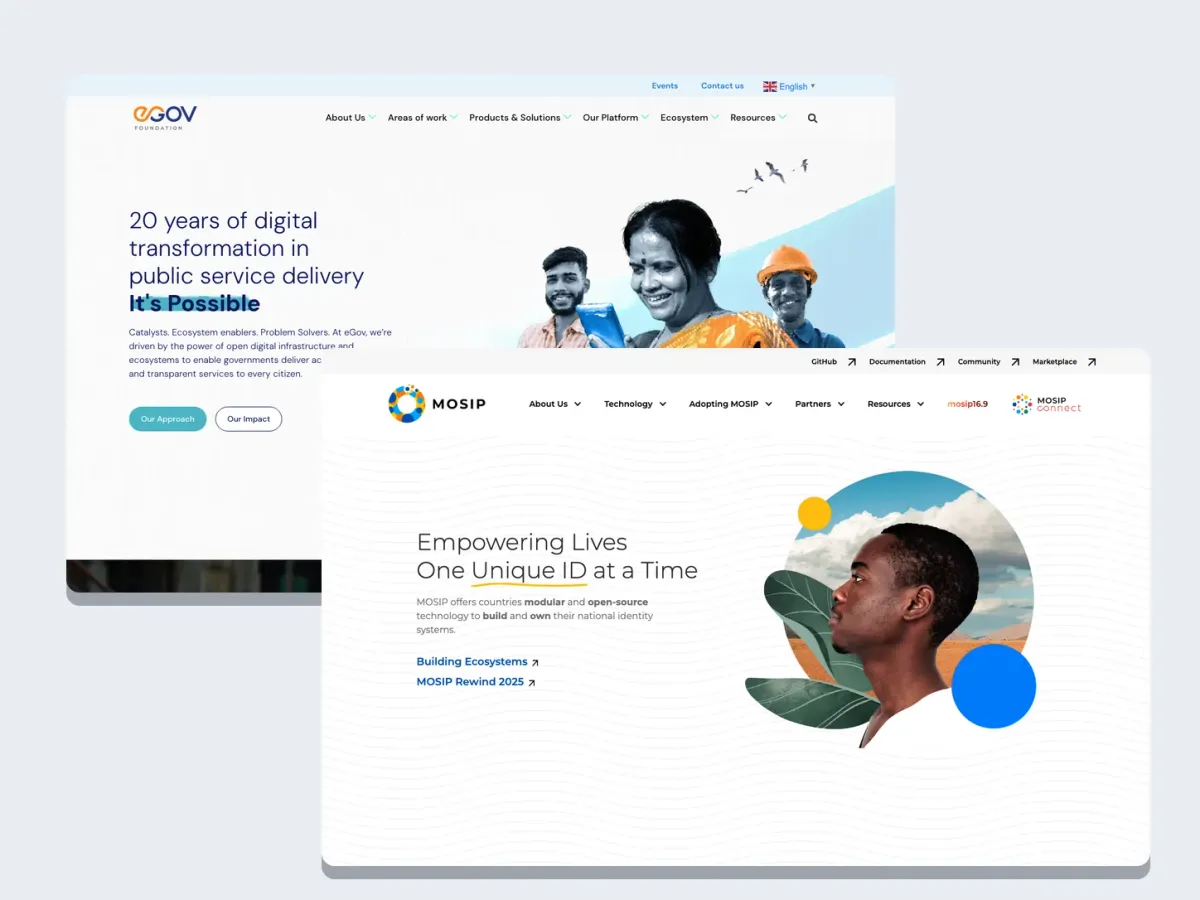
MOSIP
The MOSIP brand website
- 05/05

eGov Foundation
eGov's brand websites
We built egov.org.in, live at egov.org.in, and helped on egov.global.
What clients say about working with us is in our Clutch reviews, including one from MOSIP. More detail on websites for digital public goods and research content systems. A development programme or NGO rather than a research institute? See NGO website development.
08 Pricing
What policy website development costs
One package, sized by what you publish and how much of it moves across.
Package
Research Website
For a think tank or research institute rebuilding its site or launching a new one.
- Content model
- Publication library
- Author and topic pages
- Search
- Design
- CMS
- Editor training
₹6–20 lakh
$8,000–25,000
8–16 weeks
Care and Growth₹50,000–2 lakh a month after launch, for technical upkeep
What moves the price
- Content model complexity
- Migration volume
- Search
- Languages
- Integrations: CRM, newsletter, event tools
Every package is on pricing.
09 FAQ
Questions about research websites.
How much does a think tank website cost?
Draft range: ₹6–20 lakh ($8,000–25,000), driven mainly by the content model, how many publications are migrated, search and integrations.
How long does a research website take to build?
Typically 8–16 weeks from discovery to launch, plus migration time if you have a large archive.
Can you migrate our existing reports and keep old links working?
Yes, we migrate publications with their metadata and set up a redirect for every old URL, so citations and shared links still resolve.
Will we lose our search rankings when we move?
We map every old URL to its new one and check rankings and indexed pages before and after launch, so any drop is caught and fixed early.
Which CMS will we use?
We pick the CMS after modelling your content and your team's workflow, so it fits how your editors publish.We build on WordPress, as for egov.global and the NITI Aayog Frontier Tech Repository portal, and on other systems where your workflow needs it.
Who maintains the site after launch?
Your team runs the content; Tailwebs can cover technical maintenance through the Care and Growth plan (₹50,000–2 lakh a month).
Do we own the site and its code?
Yes. All custom code, designs and content are yours once the project is paid in full.