
For 100+ clients. Founded in Bengaluru.
01 Nonprofits and development
NGO website development, field apps and dashboards for development programmes
Tailwebs does NGO website development and builds programme dashboards, field-data apps and donation flows for nonprofits, development programmes and CSR foundations. We phase each scope to fit grant cycles and funder reporting, and design for Indian rules such as FCRA, 80G receipts and the DPDP Act. Our work includes WRI India's MobiliseHER, CSEP, Powering Livelihoods and eGov Foundation.

Client WRI India’s MobiliseHER programme: the website and the gender-mobility dashboard.
02 Development-sector work
Have you worked with organisations like ours?
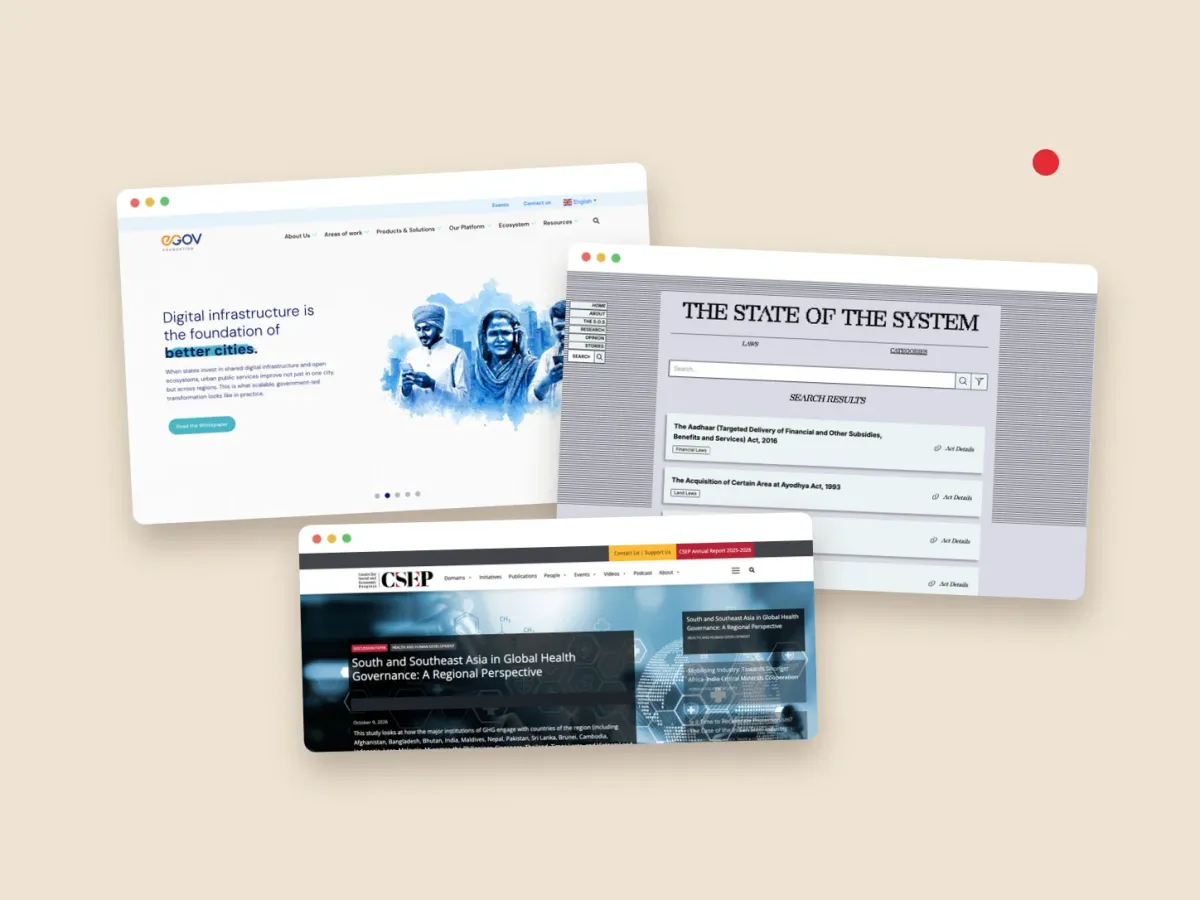
Yes. We have built for nonprofits, think tanks and development programmes: the MobiliseHER website and gender-mobility dashboard for WRI India, the Powering Livelihoods website, CSEP's website redesign, a government data dashboard for IFPRI, GFC's digital ecosystem, Crime and Punishment for Vidhi, and the eGov and MOSIP brand websites.
- 01/08
WRI India / MobiliseHER
The MobiliseHER website, and a gender-mobility dashboard on household-survey data from Bengaluru, Kochi and Ahmedabad
Puts survey data on how women travel in three cities into one view the programme and its partners can use.
- 02/08
Powering Livelihoods
The website for a CEEW–Villgro clean-energy livelihoods programme
Explains the programme and its work clearly to partners and funders.
- 03/08
CSEP
A website redesign that represents CSEP as a brand
- 04/08
IFPRI
A government data dashboard that maps many data points into one view, with each page generated from a configuration.
- 05/08
CEEW's Green Finance Centre (GFC)
Its whole digital ecosystem, including the EV dashboard, Renewables India with the Central Electricity Authority and the live Open Access tool
More on energy and climate.
- 06/08
Vidhi Centre for Legal Policy
A legal-policy think tank. Tailwebs built and maintains Crime and Punishment, a database of 7,305 crimes across 370 central laws, with AI that turns each offence into everyday language
- 07/08
eGov Foundation
eGov's brand websites: egov.org.in, with help on egov.global
- 08/08
MOSIP
The brand website, and the live Marketplace where adopting countries find compliant devices and software
What our clients say is on our Clutch reviews. More research-led work is on policy and research.
04 Built to a grant budget
Can the scope fit our grant budget?
Yes, when the plan is phased. The grant fixes the budget and extra scope needs a funder top-up, so a Discovery Sprint sets the scope, phase 1 delivers something usable within one grant tranche, and later phases line up with your funding and reporting dates.
- Step 1
Discovery Sprint
Sets the scope, the phases and what each phase delivers, before any build.
₹1.5–3 lakh
$2,000–4,000
2–3 weeks
- Phase 1
Programme or research website
Content model, resource library, search, design, a CMS and training.
₹6–20 lakh
$8,000–25,000
8–16 weeks
- Or
Programme dashboard
Data sources connected and cleaned, and a dashboard designed around your indicators.
₹4–12 lakh
$5,000–15,000
4–8 weeks
Change control is written down before work starts.
Every package is on pricing.
05 Reporting to funders
MEL dashboards that report to funders
Your MEL indicators, defined with your team, become a dashboard with exports shaped for donor reports and a programme view you can give funders access to.
Analytics and impact dashboards built so the quarterly report starts from the dashboard, not from a hunt through spreadsheets. The gender-mobility dashboard we built for WRI India's MobiliseHER joins household-survey data from Bengaluru, Kochi and Ahmedabad in one view, and the GFC dashboards we built are used 10,000+ times a month, including by state agencies.
What funders can see- Indicators defined with your team
- Outputs by partner, place and quarter
- Exports shaped for donor reports
- A read-only view for each funder
- Survey, field and partner data, joined
How we build them: dashboard development.
06 After the grant
Who runs it after the grant ends, and what does it cost?
Your team can. Hosting sits in accounts you own, an editor-friendly CMS with roles and training lets a small team or volunteers publish safely, and the code and documentation are handed over so your team or another vendor can run it.
Ongoing care is optional, through the Care and Growth plan: ₹50,000–2 lakh a month. Every plan is on pricing.
Handover · for a small teamDraft terms
- Hosting in your accountsCloud, domain and email in your organisation’s name.
- An editor-friendly CMSRoles for staff and volunteers, and a training session.
- Code and documentationSo your team or another vendor can run it.
- When the programme endsProject microsites folded into your main site, or archived properly.
- Running costs, estimatedHosting, domain and maintenance, estimated before launch.
07 Rules we design for
Do you understand donation and beneficiary-data rules?
Yes: these are the rules we plan around for donations, CSR funding and the people your programme serves. Your adviser or auditor decides what applies.
Knowledge, not certification · not legal advice
Donations
Shapes the donation flow, the receipts and how foreign money is kept apart.
- The Foreign Contribution (Regulation) Act, for foreign contributions: current rules on fcraonline.nic.in.
- Section 80G of the Income Tax Act, for donors’ tax deductions: current rules on incometaxindia.gov.in.
- RBI directions on recurring payments, for monthly giving: current directions on rbi.org.in.
CSR funding
Shapes what a CSR-funded project reports, and to whom.
- Section 135 of the Companies Act 2013, on CSR spending: current rules on mca.gov.in.
People and data
Shapes consent, what is collected about beneficiaries, and the extra care children’s data needs.
- The DPDP Act and Rules, on consent and personal data, including children’s data: current text on meity.gov.in.
- UK GDPR and EU GDPR, for international donors or EU funding: see ico.org.uk and eur-lex.europa.eu.
Accessibility
Shapes how every page is designed and tested.
- The W3C’s Web Content Accessibility Guidelines, which many buyers need to meet.
Who signs off
Your FCRA adviser, auditor or legal team decides what applies; we build to their requirements.
08 FAQ
Questions about NGO website development.
Do you offer nonprofit pricing?
We phase each scope so that each phase fits a grant tranche.
Can the project be split to match our grant cycle?
Yes, we plan phases that each deliver something usable and line up with your funding and reporting dates.
In donation platform development, can 80G receipts be issued automatically?
Yes. A donation platform can generate receipts with the details your finance team needs, and we plan for 80G from the start; your auditor confirms the format.
Can you handle foreign donations under FCRA?
Yes. We keep foreign and domestic contributions separate in the donation flow and its records, and your FCRA adviser confirms the setup. The current rules are on fcraonline.nic.in.
Can field staff collect data offline?
Yes, we build apps that store data offline and sync when the device is back online.
How do you protect beneficiary data?
We collect only what the programme needs, record each person’s consent, restrict access by role and keep data in accounts you own where possible.
Who maintains the platform after the grant ends?
Your team, another vendor or us. We hand over the code and documentation so anyone can run it, or we look after it through the Care and Growth plan at ₹50,000–2 lakh a month.