
01 AI and LLMs
LLM development company for AI features that work from your own data
Tailwebs is an LLM development company that builds large language model features into products: chatbots that answer from your own content, AI extraction from documents and data, and assistants inside apps. Our shipped AI work includes the NITI Aayog Frontier Tech Repository portal with its NFTR Assistant, AI extraction behind Vidhi's Crime and Punishment database, and our own TailGPT.


02 Shipped
Generative AI development we've built
Four pieces of AI work: two for clients and two of our own products.
- 01
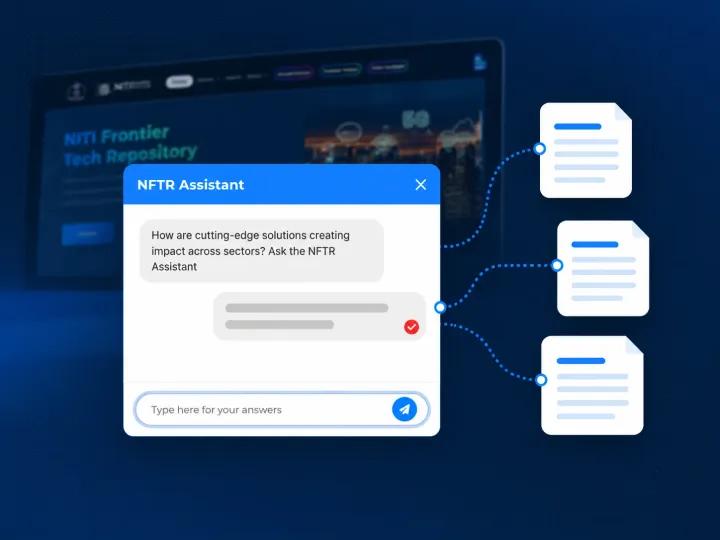
NFTR Assistant
Built into the NITI Aayog Frontier Tech Repository portal, which we built: a chatbot that answers from the knowledge base, cites its sources and reports unanswered questions to admins. Shows: answers grounded in sources, citations, and a log of the gaps.
- 02
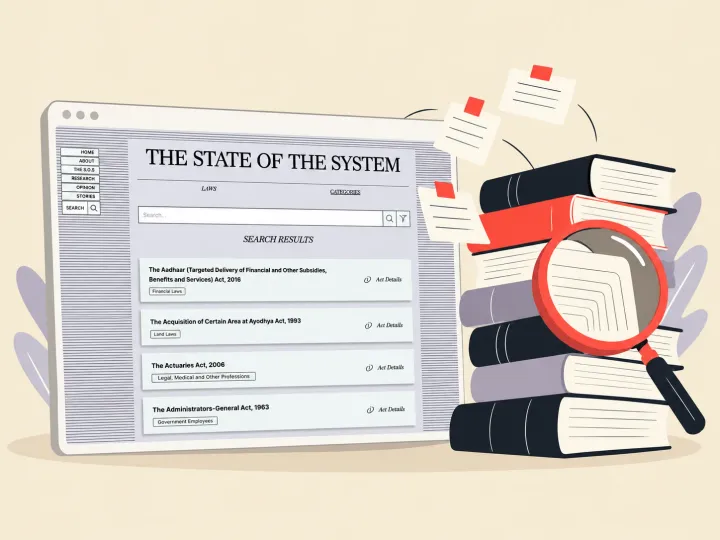
Crime and Punishment
For Vidhi Centre for Legal Policy: a scraping engine plus AI extracts punishment data and tags law sections, for a database of 7,305 crimes across 370 central laws that Tailwebs built and maintains. Shows: extraction at scale. Live at crimeandpunishment.in.
- 03
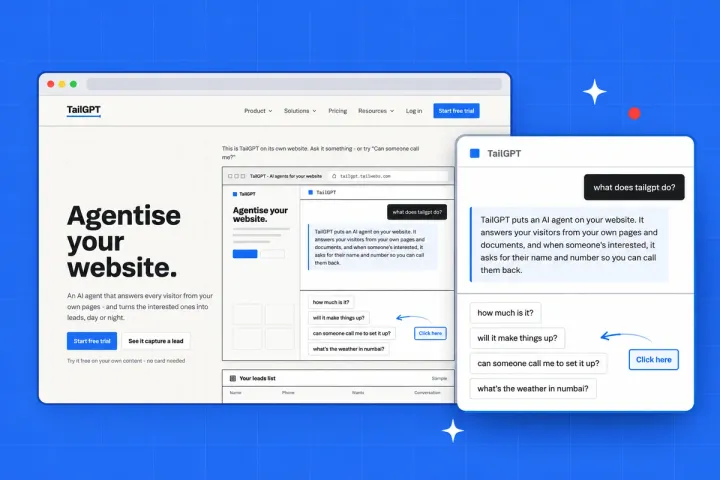
TailGPT, our own product
AI agents for your website, built from your own content. Shows: running an AI product ourselves. See TailGPT.
- 04
Tailwebs Operator, our own product
An engine that automates business processes through AI assistants: it interviews you, then builds them. Each assistant sorts actions into auto, draft or ask. Shows: AI that does the work. See Tailwebs Operator.
We also run Kaipo, our own conversational AI app, and 200+ AI agents work in our own delivery process alongside 50+ people.
See what clients say in our Clutch reviews.
The same methods cover search across reports, summaries of long documents and assistants inside existing apps. To scope one as a project, see AI development, AI chatbot development or AI automation.
05 Evaluation
Tested on your own questions, before it goes live
Quality is checked on your own questions, not promised. Our own products show how: TailGPT checks each cited fact against its source page and says when the site doesn't cover something, and every assistant Tailwebs Operator builds passes red-team probes before it goes live.
Start from your questions
The feature is tested on real questions from your organisation, chosen with your team.
For example The questions your users already ask, each with the answer your team would give.
Check answers against sources
Each answer is checked against the source it cites, so a wrong answer shows up before your users see it.
For example TailGPT checks each cited fact against its source page, and says when the site doesn't cover a question.
Probe it before launch
We test before release, the way we do on our own products.
For example Every assistant Tailwebs Operator builds passes red-team probes before it goes live.
Learn from live questions
After launch, the questions it couldn't answer show your team where the content has gaps.
For example The NFTR Assistant reports unanswered questions to admins, and TailGPT shows a 7-day view of what the site couldn't answer.
Live questions show the gaps
07 Running cost · draft
Cost per conversation, worked out before launch
The monthly bill is worked out before launch: the tokens in a conversation, times the model's price, times your expected volume, plus retrieval and hosting.
- Tokens per conversationThe question, the passages sent with it, and the answer.
- The model's pricePer token, from the provider's own price list at the time.
- Expected volumeConversations a month, at launch and a year on.
- Retrieval and hostingThe search index and the servers that run the feature.
- Low use, under 5,000 conversations a month: about ₹3,000–15,000 a month in AI usage.
- Medium use: about ₹15,000–60,000 a month.
- High use: ₹60,000+ a month.
Levers that lower it
Simple questions routed to a smaller model, repeated answers cached, and context kept short.
AI usage is billed from your own provider account where possible. The full guide is what an AI app costs to build and run.
08 Your data
Where your data lives
Five points decide where your data goes: the region, the accounts, training, the server and the law.
Working with policy or public-sector data? These points are the ones to settle first, before any document is shared.
- Where it is stored and processed
- In the region your rules require, agreed with you before any document is shared.
- Accounts
- In accounts you own where possible.
- Training on your data
- Whether the model provider may train on your data is checked against its terms for each project.
- Running on your own server
- Where your rules need it, we can run the system on your own server or cloud account, agreed before the build.
- Data protection law
- We work under India's DPDP Act 2023, and GDPR where it applies.
09 FAQ